Freelance Service Agreement: What It Is and How to Write One
The Stoatify team

A freelance service agreement is a contract between an independent professional and a client. It records what the freelancer will do, what the client will pay, who owns the finished work, how either party can end the engagement, and what happens when the project changes. A clear agreement turns a promising conversation into a shared set of expectations before anyone starts work.
This guide explains the clauses commonly found in a freelance contract and gives you a practical drafting process. It provides general educational information, not legal or tax advice. Contract requirements and enforceability vary by location and project. Ask a qualified lawyer to review language involving substantial fees, regulated work, international parties, unusual intellectual property, or significant liability.
What is a freelance service agreement?
The agreement is the main rulebook for a freelance engagement. It can cover one project, a fixed period, or an ongoing relationship. Some businesses pair a master services agreement with a separate statement of work for each project. For a straightforward engagement, one freelance service agreement can contain both the general legal terms and the project-specific scope.
The document is useful to both sides. The client can define deliverables, deadlines, approval standards, and rights in the final work. The freelancer can define payment triggers, revision limits, dependencies, cancellation fees, and the right to pause work after nonpayment. If a disagreement arises, both parties can return to the same written record instead of relying on different memories of a call or chat.
It is easy to skip the paperwork when a project feels friendly and the deadline is close. The difference shows up later, the first time scope, payment, or ownership is questioned:
- Scope lives in memory and scattered chat threadsScope, deliverables, and exclusions are written and measurable
- Payment timing is assumed and easy to disputeDeposit, milestones, and due dates are defined, with a right to pause on nonpayment
- Revisions are open-ended and unpaidIncluded rounds plus a paid change-order process
- Who owns the finished work stays unclear until it mattersOwnership or a license transfers in writing, often on full payment
- Ending the engagement is improvisedTermination, final payment, and handoff duties are spelled out
- A dispute pits one person's memory against another'sBoth sides return to a single signed record
A contract label does not decide worker status
Calling someone a freelancer or independent contractor does not make that classification correct. The IRS says federal worker classification depends on the actual relationship and considers behavioral control, financial control, and the parties' relationship. It also states that the substance of the relationship governs, regardless of its label. State and local tests can differ. Before using a freelance agreement, confirm that the working arrangement truly fits contractor status and get professional advice when the answer is uncertain.
How to write a freelance service agreement
Start with the commercial deal in plain language, then make every important promise specific enough that an unfamiliar reader could understand it. Use consistent defined terms, fill every blank, remove clauses that do not apply, and check that the scope, fee schedule, and signature page all identify the same parties and project.
1. Identify the parties and effective date
Use each party's full legal name, entity type, business address, and notice email. A brand name may not be the legal party responsible for payment. If a limited company or corporation is contracting, name that entity and have its authorized representative sign in that capacity. State when the agreement takes effect and, if relevant, when services begin and end.
2. Define the services, deliverables, and exclusions
Describe the work in measurable terms. List every deliverable, its format, delivery method, milestones, target dates, and acceptance criteria. State what the client must provide, such as access, source files, feedback, or approvals, and explain how client delays affect the schedule. Add explicit exclusions so silence is not mistaken for inclusion. For example, a website design scope might exclude copywriting, hosting, paid fonts, ongoing maintenance, and development.
- Weak scope: Design a website for the client.
- Stronger scope: Deliver responsive designs for five named page types in Figma, including desktop and mobile layouts, one clickable prototype, and two consolidated revision rounds.
- Useful exclusions: Development, copywriting, stock assets, domain fees, and work on pages not listed in the agreement require a written change order.
3. Set milestones, feedback, and acceptance
Give each party a workable timeline. State when the freelancer will submit a milestone, how long the client has to review it, who can approve it, and what counts as acceptance. If silence after a review period counts as acceptance, say so clearly and choose a reasonable period. Require feedback to be consolidated through one client contact so conflicting requests do not create accidental rework.
4. Explain fees, invoices, expenses, and late payment
State whether pricing is fixed, hourly, daily, retainer-based, or tied to milestones. For time-based work, include the rate, billing increment, estimate or cap, and approval process for exceeding it. For fixed fees, connect payments to objective events such as signing, milestone approval, or delivery. Include the deposit, invoice schedule, currency, taxes, payment method, due date, reimbursable expenses, and any lawful late fee or interest. Explain whether work pauses when an invoice becomes overdue and whether deposits are refundable.
5. Control revisions and scope changes
Revision limits protect the budget without preventing useful collaboration. Define what one revision round means, how many are included, and the rate for additional work. Then add a change process: either party documents the requested change, and the freelancer states its effect on price and timing before work begins. Both parties approve the change in writing. This creates a clean boundary between refining an agreed deliverable and adding another deliverable.
6. Decide who owns the work
Separate final deliverables from the freelancer's pre-existing tools, methods, templates, fonts, code libraries, and working files. State whether the client receives an assignment of ownership or a license, which rights are included, the permitted uses, and when those rights take effect. Freelancers often make a transfer conditional on full payment and retain ownership of reusable background materials while licensing what the client needs to use the deliverable.
Do not assume that paying for creative work automatically transfers copyright. Under U.S. copyright law, copyright initially belongs to the author in the ordinary case, and a transfer of copyright ownership generally must be in writing and signed by the rights owner. The work-made-for-hire rules are limited and technical. Use precise ownership language and obtain legal review when intellectual property is central to the deal.
7. Address confidentiality and portfolio use
Define confidential information, the permitted purpose for using it, who may receive it, reasonable protection duties, and standard exclusions such as information already public or independently developed. Set a practical duration and explain return or deletion duties. If the freelancer wants to display finished work in a portfolio, say when that is allowed, such as after the client's public launch, and carve out confidential material. A separate non-disclosure agreement can be appropriate when sensitive discussions begin before the service agreement.
8. Cover independent work, subcontractors, and conflicts
Describe the freelancer as an independent business responsible for its own methods, tools, insurance, and taxes, without employee benefits. Avoid language that contradicts the real arrangement. State whether subcontracting requires consent and require approved subcontractors to follow relevant confidentiality and intellectual property duties. If exclusivity or a non-solicitation restriction is genuinely necessary, keep it narrow and have local counsel check enforceability.
9. Allocate risk carefully
Representations, warranties, indemnities, liability caps, and insurance clauses decide who bears particular losses. They can have consequences far beyond the project fee. Write any promise so the party making it can realistically comply. Consider a reasonable cap on damages, exclusions for indirect losses, and specific treatment for confidentiality, infringement, fraud, or data incidents. These clauses are highly dependent on the work and governing law, so professional review is especially valuable here.
10. Explain termination and the final handoff
Cover termination for an uncured breach and, if desired, termination for convenience with advance notice. State what the client owes for completed work, committed costs, and any cancellation fee. Explain which files must be delivered, whether unfinished work can be used, what happens to licenses, and which duties survive, such as payment, confidentiality, ownership, dispute terms, and limits of liability.
11. Add governing law, disputes, notices, and complete-agreement terms
Choose a governing law and a practical forum or dispute process. Do not copy an arbitration clause without understanding its cost and effect. Add a notice method, rules for amendments, assignment, severability, waiver, counterparts, and the parties' entire agreement. If a statement of work or attachment conflicts with the main agreement, state which document controls.
12. Review and sign the final agreement
Proofread names, dates, cross-references, money, and attachments. Make sure every negotiated change appears in the final version and every signer has authority. The federal E-SIGN Act generally provides that a contract or signature in interstate or foreign commerce cannot be denied legal effect solely because it is electronic, while preserving other legal requirements and exceptions. Consent, intent, attribution, a final record, and compliance with applicable law still matter.
A practical freelance agreement checklist
- Correct legal names, addresses, effective date, and authorized signers
- Specific services, deliverables, exclusions, milestones, and client dependencies
- Fees, deposit, invoice timing, taxes, expenses, late payment, and pause rights
- Included revisions plus a written change-order process
- Acceptance criteria and a reasonable review period
- Ownership or license terms for final work, background materials, and working files
- Confidentiality, data handling, publicity, and portfolio permissions
- Accurate contractor relationship terms and any subcontractor rules
- Appropriate warranties, indemnities, insurance, and liability limits
- Termination rights, final payment, handoff duties, and surviving clauses
- Governing law, disputes, notices, amendments, and order of precedence
- All attachments included and the final version signed by both parties
Create and send a freelance service agreement with Stoatify
Stoatify gives you a prebuilt Freelance Service Agreement that you can adapt to the real engagement. Open the template, replace the sample party and project details, expand the scope and payment terms, refine the ownership and confidentiality clauses, and remove anything that does not fit. Add signature, printed-name, and date fields for the freelancer and client, then review the generated document before sending it.
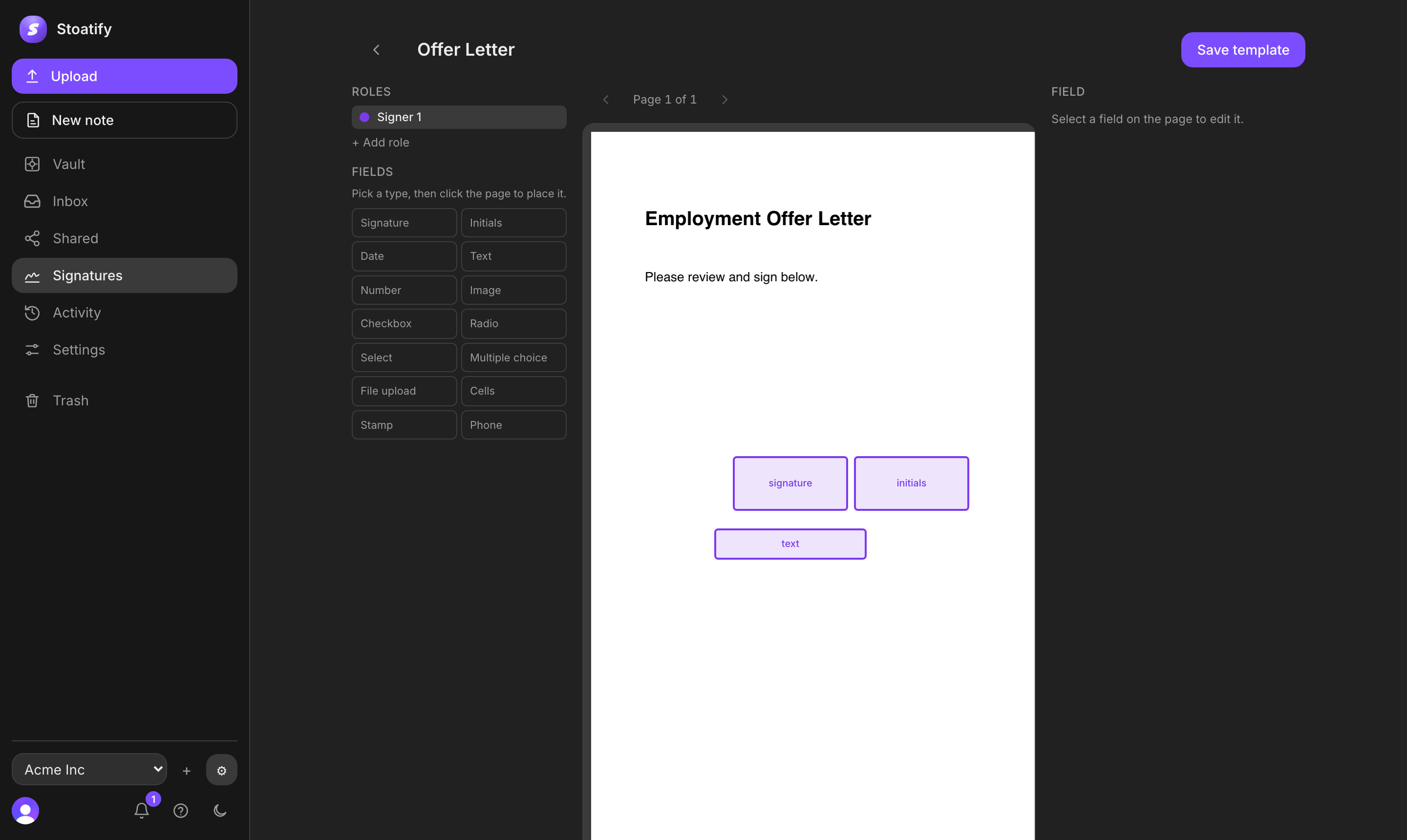
Send the finished agreement from Stoatify for legally binding e-signatures. Each signer completes a guided signing flow from any device, without creating an account. Stoatify records signing events in a complete audit trail and produces a tamper-evident certificate. The sealed PDF returns to your organized, searchable vault, keeping the signed contract beside the rest of the project's documents instead of creating another file hunt.
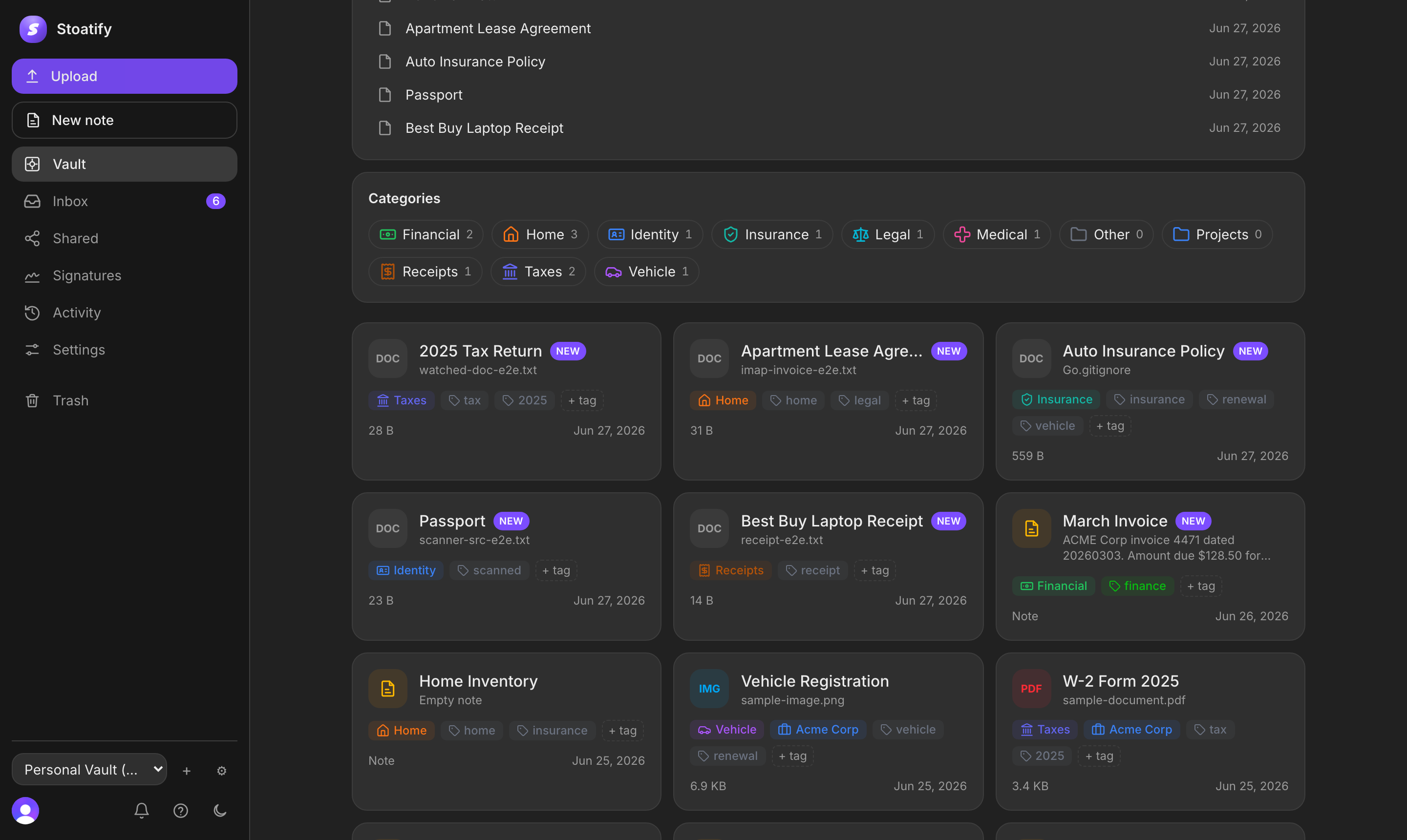
Electronic signatures do not fix unclear terms, an unauthorized signer, or a contract that violates applicable law, so treat the template as a strong starting point and get legal advice when the stakes call for it. With the draft, the signing trail, and the sealed final record together in one place, the agreement stays as organized as the rest of your work. The freelancer document checklist covers what else belongs in that record and how long to keep it, and organizing client documents as a freelancer covers where to keep a downloaded signed agreement.
Authoritative sources
- IRS, Topic No. 762, Independent Contractor vs. Employee
- IRS, Employee (Common-Law Employee)
- U.S. Copyright Office, Copyright Act Chapter 2, Sections 201 and 204
- U.S. Copyright Office, Circular 30, Works Made for Hire
- U.S. Government Publishing Office, Electronic Signatures in Global and National Commerce Act, 15 U.S.C. 7001