Independent contractor agreement: what it is and how to write one
The Stoatify team

An independent contractor agreement is a written contract between a client and a self-employed person or business. It records the result the contractor will deliver, the commercial terms, ownership of the work, confidentiality duties, and how either side can end the engagement. A clear agreement gives both parties the same reference point before work and payment begin.
This guide provides general educational information, not legal or tax advice. Contract rules and worker-classification tests vary by jurisdiction and circumstances. Ask a qualified lawyer or tax professional to review an agreement when the relationship, intellectual property, regulated data, or potential liability is significant.
What an independent contractor agreement does
The agreement translates a business arrangement into specific obligations. It identifies who is hiring whom, defines the services and acceptance criteria, states when and how the contractor is paid, and allocates risks that might otherwise be left uncertain. It can also establish that the contractor controls the manner and means of performing the work, supplies their own tools, handles their own taxes, and is not entitled to employee benefits, when those statements match reality.
The label is not decisive. In the United States, the IRS examines behavioral control, financial control, and the parties' relationship. The Department of Labor uses its own Fair Labor Standards Act analysis. State laws may apply different tests. A contract calling someone an independent contractor cannot cure an employment relationship that functions like employment in practice.
Classification turns on how the relationship actually works, not on what the contract calls it. These are the differences the tests tend to weigh:
- The employer directs how and when the work is doneControls the manner and means of the work, subject to deadlines
- Uses the employer's tools and workspaceSupplies their own tools, equipment, and workspace
- Taxes are withheld from each paycheckInvoices for the work and handles their own taxes
- Receives benefits, overtime, and minimum wageNo employee benefits; paid according to the agreement
- Typically works for a single employerFree to serve several clients at once
When to use this agreement
- A business hires a consultant, designer, developer, photographer, bookkeeper, tradesperson, or other self-employed provider for a defined engagement.
- A contractor wants written approval of scope, payment dates, expenses, revision limits, and ownership before starting work.
- The relationship will continue across several projects and needs standing legal terms, with separate statements of work for each assignment.
- Either party will disclose confidential information or create intellectual property that needs clearly assigned rights.
Do not use the agreement simply to avoid payroll, benefits, minimum wage, overtime, or other employment obligations. Check the actual working relationship against every applicable federal, state, provincial, and local classification test.
How to write an independent contractor agreement
1. Identify the parties and effective date
Use each party's complete legal name, entity type, address, and notice details. State the date the agreement takes effect. If a company is signing, confirm the signer's title and authority. Define short names such as Client and Contractor and use them consistently.
2. Define services, deliverables, and acceptance
Describe the work in measurable terms. List each deliverable, required format, milestone, deadline, dependency, and person responsible for approvals. Explain how the client will review work, how long the review period lasts, what counts as acceptance, and how many revision rounds are included. For recurring work, keep the main agreement stable and attach a statement of work for each project.
3. Set fees, invoices, expenses, and taxes
State whether pricing is fixed, hourly, daily, milestone-based, or on retainer. Include the currency, deposit, invoice schedule, payment method, due date, late-payment treatment, and any taxes added to the invoice. Say which expenses require advance written approval and whether receipts are required. Address what happens to earned fees, deposits, and unfinished milestones if the engagement ends early.
4. Describe the independent relationship accurately
Record facts that are genuinely true: the contractor operates an independent business, controls how and when the services are performed subject to deadlines, may serve other clients, provides tools or insurance, bears business expenses, and is responsible for applicable taxes. Avoid provisions that contradict daily practice. Detailed control over schedules, methods, training, exclusivity, and ongoing work can point toward employee status even when the contract uses contractor language.
5. Allocate intellectual property rights
Separate pre-existing materials from project deliverables. Identify what the contractor retains, what is licensed to the client, what is assigned, when ownership transfers, and whether full payment is a condition of transfer. Cover source files, third-party assets, open-source components, portfolio use, moral rights where permitted, and the scope, territory, duration, and exclusivity of any license. Intellectual property language is jurisdiction-specific, so obtain legal review when ownership matters.
6. Protect confidential information and data
Define confidential information, permitted uses, safeguards, allowed recipients, exclusions, and the duty to return or destroy information. Set a sensible duration and account for trade secrets, which may require different treatment. When sensitive material changes hands before this agreement is signed, a standalone non-disclosure agreement can cover the gap. If the contractor handles personal, health, payment, or regulated data, add the required privacy, security, breach-notification, and subcontractor terms rather than relying on a general confidentiality paragraph.
7. Address warranties, liability, insurance, and indemnity
State the promises each party makes, such as authority to enter the contract, professional performance, and non-infringement. Define any remedy period. If the agreement includes disclaimers, liability caps, indemnities, or insurance requirements, make them proportionate to the project and have counsel review them. These clauses can shift substantial financial risk and their enforceability varies.
8. Set the term and exit process
Specify whether the contract runs until a date, completion, or termination. Explain termination for convenience and for breach, required notice, any cure period, final payment, handoff of work, return of property, and which clauses survive. A practical exit clause prevents a stalled project from becoming an indefinite obligation.
9. Add dispute and standard contract terms
Choose governing law and a dispute process with professional advice, especially when the parties are in different places. Consider negotiation, mediation, courts, or arbitration and identify the forum. Complete the agreement with notices, assignment, subcontracting, force majeure, amendment, waiver, severability, entire-agreement, counterpart, and electronic-signature provisions appropriate to the deal.
A practical drafting checklist
- Match the contract to how the relationship will operate in practice.
- Replace vague goals with named deliverables, dates, owners, and acceptance rules.
- Connect each payment milestone to an objective event.
- Resolve intellectual property ownership before either side shares source materials or begins production.
- Use consistent defined terms and remove blanks, drafting notes, and inapplicable alternatives.
- Confirm every referenced schedule, statement of work, policy, and exhibit is attached.
- Have both parties review the final version and retain the signed record and audit evidence.
Create, send, and store the agreement with Stoatify
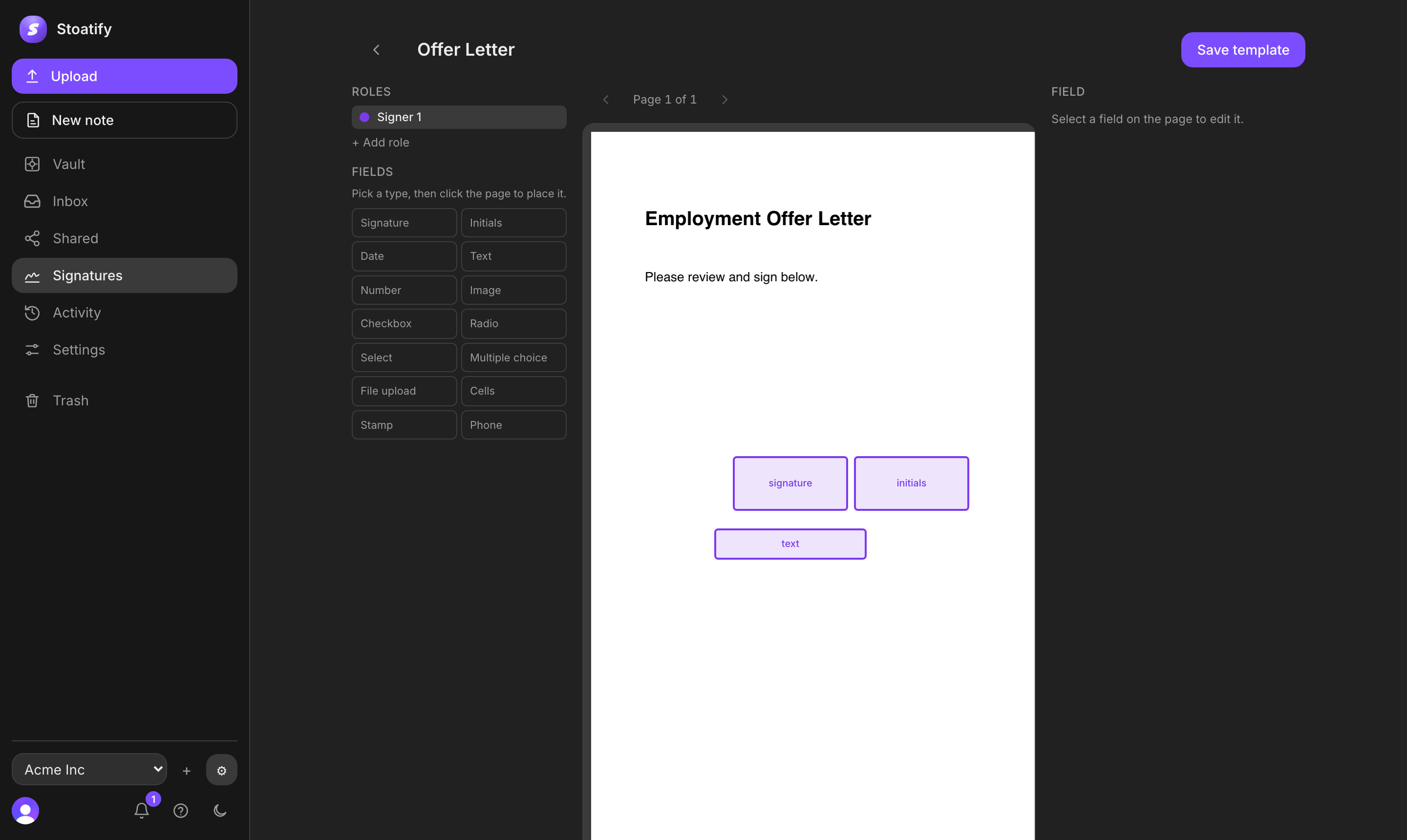
Stoatify includes a prebuilt Independent Contractor Agreement. Open the template gallery, choose the agreement, and edit the names, services, payment terms, ownership language, confidentiality duties, and other clauses for the engagement. Review the final contract, place the required signature and date fields, assign them to the client and contractor, and send the signing link. Signers can complete it from any device without creating an account.
In the United States, the federal E-SIGN Act generally provides that a contract or signature in interstate or foreign commerce cannot be denied legal effect solely because it is electronic, subject to its scope, consent rules, exceptions, and other applicable law. Legal enforceability still depends on the contract, authority, intent, process, and jurisdiction. Stoatify records the signing activity, cryptographically seals the completed PDF, produces an audit certificate, and keeps the signed result in the same organized vault as the working version.
Save the customized agreement as a reusable Stoatify template for the next engagement. Update the project-specific terms each time, send it for e-signature, and keep each completed contract searchable and versioned rather than scattered across email attachments and download folders. Organizing client documents as a freelancer covers where to keep the downloaded signed contract, and the freelancer document checklist covers the rest of the records an engagement produces.